Project Title
Herbal Bioactive Compound Analysis and Applied Product Development Programme
Programme Leader / Trainer
Assoc. Prof. Dr. Rawiwan Charoensup / Director of Medicinal Plants Innovation Center
Programme Overview (Brief Description)
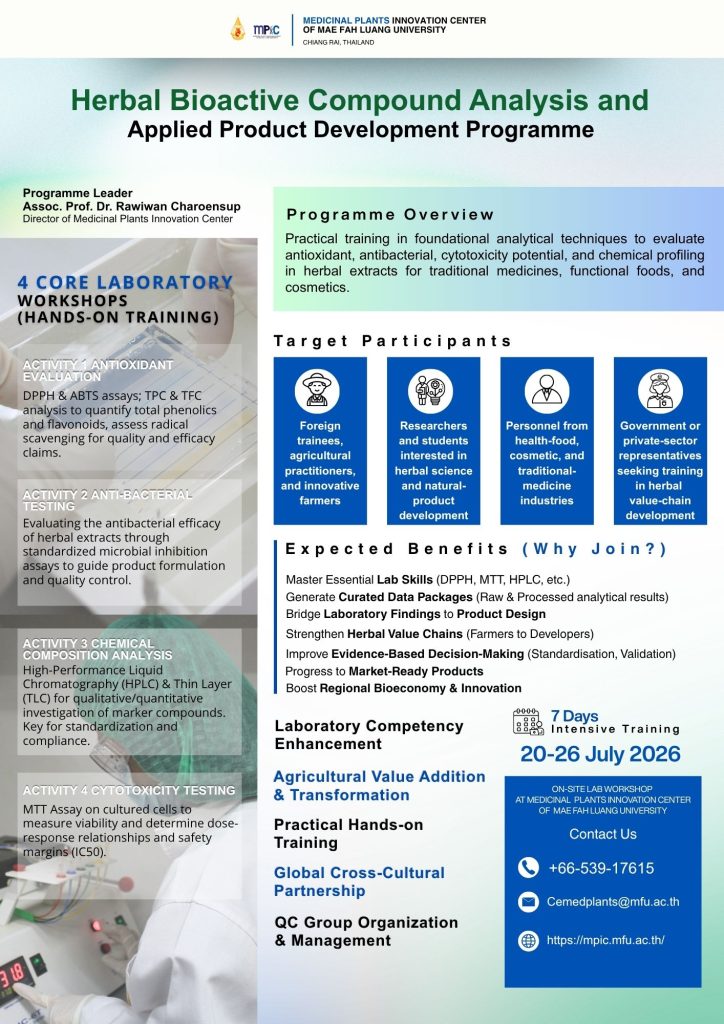
Practical training in foundational analytical techniques to evaluate antioxidant, antibacterial, cytotoxicity potential, and chemical profiling in herbal extracts for traditional medicines, functional foods, and cosmetics.
Activity 1: Antioxidant Activity Evaluation Using DPPH, ABTS Assays, and Quantification of Total Phenolic and Flavonoid Contents
This activity introduces participants to foundational analytical techniques used to evaluate antioxidant potential in herbal extracts and extract-derived products. Antioxidant properties are critical quality indicators in traditional medicines, functional foods, and cosmetic formulations, as they contribute to anti-aging effects, oxidative stress reduction, and product stability. The activity integrates two radical scavenging assays—DPPH and ABTS—with quantitative determination of Total Phenolic Content (TPC) and Total Flavonoid Content (TFC) to provide a comprehensive assessment of antioxidant capacity and phytochemical richness.
DPPH Radical Scavenging Assay: Participants will learn the principles of the 2,2-diphenyl-1-picrylhydrazyl (DPPH) free radical assay, which measures the ability of compounds in herbal extracts to donate hydrogen atoms or electrons to neutralize free radicals. The reduction in DPPH absorbance reflects the antioxidant activity of the sample. This assay is widely applied to evaluate herbal extracts and herbal-based products such as tinctures, oils, capsules, functional beverages, and cosmetic serums to support claims related to oxidative protection and anti-aging benefits.
ABTS Radical Cation Decolorization Assay: The ABTS assay assesses antioxidant capacity in both hydrophilic and lipophilic components, making it suitable for a diverse range of herbal formulations including emulsions, creams, balms, powders, and food matrices. The principle involves the reduction of the ABTS⁺ radical cation by antioxidants present in the sample, leading to decreased absorbance. This method allows for comparison of antioxidant strength across different herbal-derived products and supports formulation optimization.
Total Phenolic Content (TPC) Analysis: TPC measurement, commonly using the Folin–Ciocalteu method, quantifies phenolic compounds—key antioxidants found abundantly in medicinal plants. Phenolics contribute significantly to the biological activities of herbal extracts, including anti-inflammatory, antimicrobial, and anti-aging properties. Participants will learn to prepare calibration curves, perform colorimetric measurements, and relate TPC values to the quality and efficacy of herbal extract-based products such as herbal teas, nutraceutical capsules, and botanical cosmetic formulations.
Total Flavonoid Content (TFC) Analysis: Flavonoids represent a major class of phytochemicals responsible for antioxidant, anti-inflammatory, and anti-microbial effects in herbal extracts. TFC analysis (typically via aluminum chloride colorimetric assay) enables quantification of these compounds in plant extracts and extract-derived products. Understanding flavonoid levels helps participants evaluate the potency of herbal extracts used in functional foods, skincare products, and traditional remedies, and supports product standardization and quality control.
Integration with Herbal Extract and Product Development: Together, DPPH, ABTS, TPC, and TFC provide a robust analytical framework for evaluating antioxidant capacity and phytochemical richness in herbal extracts and their derived products. This integrated approach is essential for:
- Supporting scientific claims for product efficacy
- Selecting high-quality raw materials for innovative farming and processing
- Guiding formulation of health foods, nutraceuticals, and cosmetics
- Establishing quality benchmarks for traditional medicine ingredients
- These methods empower participants to understand how phytochemical composition influences biological activity and product performance, thereby strengthening evidence-based development of herbal-based innovations.
Activity 2: Anti-bacterial Activity Testing Using Agar Diffusion (Zone of Inhibition) Assay
This activity introduces participants to the principles and practical techniques of antibacterial evaluation using the Agar Diffusion (Zone of Inhibition) Assay, a standard and widely accepted screening method for determining the antimicrobial potential of natural extracts and herbal-derived products. This assay is especially useful in the early stages of product development for traditional medicines, functional foods, and cosmetic formulations where microbial contamination and product preservation are key considerations.
Participants will learn how plant extracts and extract-based formulations—such as herbal tinctures, balms, lotions, gels, and natural preservatives—can be tested for their ability to inhibit the growth of common pathogenic or spoilage-causing bacteria. The activity emphasizes the role of natural bioactive compounds in enhancing product safety, extending shelf life, and supporting claims related to antimicrobial properties.
Key components include:
- Introduction to antibacterial mechanisms and relevance to natural product applications
- Preparation of bacterial cultures and agar plates under aseptic conditions
- Application of herbal extracts and extract-based product samples into wells or onto discs
- Incubation and observation of microbial growth inhibition
- Measurement and interpretation of zones of inhibition as an indicator of antibacterial activity
- Discussion on how assay results support product development, quality control, and formulation decisions
- Through this activity, participants gain essential laboratory skills while developing an understanding of how herbal bioactive contribute to the safety, efficacy, and market value of health and cosmetic products.
Activity 3: Chemical Composition Analysis Using HPLC and Thin Layer Chromatography (TLC)
This activity provides participants with in-depth analytical skills for characterizing the chemical profiles of herbal extracts and extract-based products through two complementary chromatographic techniques: High-Performance Liquid Chromatography (HPLC) and Thin Layer Chromatography (TLC). These methods are essential tools for evaluating the presence, concentration, and consistency of key bioactive constituents in traditional medicine, functional food, and cosmetic formulations.
High-Performance Liquid Chromatography (HPLC): Participants will be trained in advanced chromatographic separation and quantification methods that enable precise identification of marker compounds and phytoconstituents in herbal extracts.
Key training components include:
- Principles of liquid chromatographic separation and detector selection
- Preparation of standards and calibration curves
- Sample preparation, filtration, and mobile-phase optimization
- Instrument operation: system suitability, injection, and run monitoring
- Chromatogram interpretation for identification and quantification of bioactive compounds
- HPLC forms the foundation for product standardization, quality control, and regulatory documentation, enabling participants to understand how chemical profiles influence efficacy, safety, and product compliance.
Thin Layer Chromatography (TLC): TLC is introduced as a rapid, cost-effective, and versatile analytical tool widely used in herbal authentication, preliminary screening, and quality differentiation of plant-based raw materials and formulations.
- Participants will learn the complete TLC workflow, including:
- Selection of stationary and mobile phases
- Sample spotting and plate development
- Visualization techniques (UV, spraying reagents, derivatization)
- Identification of characteristic bands
- Semi-quantitative assessment using Rf values
- TLC provides a practical approach for:
- Detecting adulteration or substitution of herbal raw materials
- Comparing different extract batches for consistency
- Generating chemical fingerprints to support authentication and standardization
- Preliminary screening prior to HPLC quantification
Integration with Natural Product Research and Product Innovation: By combining TLC (qualitative chemical fingerprinting) with HPLC (quantitative chemical profiling), participants gain a holistic analytical toolkit to evaluate the composition, purity, and quality of herbal extracts and derived products. These methods support:
- Evidence-based development of traditional medicines
- Quality benchmarking for functional foods and nutritional ingredients
- Ingredient validation and compliance for cosmetic formulations
- Strengthening value chains between innovative farmers and product developers
- This integrated analytical approach enables participants to bridge laboratory findings with product design, regulatory alignment, and market-readiness strategies.
Activity 4: Cytotoxicity Testing Using MTT Assay
This activity focuses on evaluating the potential toxicity of natural extracts on cultured cells, which is a critical step in the safety assessment of traditional medicines, functional foods, and cosmetic ingredients. Participants will learn how to determine the cytotoxic effects of test samples and how to interpret dose–response relationships.
Key components include:
- Fundamentals of cell culture, aseptic techniques, and cell viability assessment
- Preparation and treatment of cells with different concentrations of plant or natural extracts
MTT Assay: Measurement of mitochondrial metabolic activity as an indicator of cell viability and cytotoxicity
- Calculation of percentage cell viability and, where applicable, estimation of IC₅₀ values
- Discussion on safety margins and relevance of cytotoxicity data for product development
- This activity strengthens participants’ ability to assess the safety profile of bioactive compounds and to integrate cytotoxicity data into decision-making for product formulation and regulatory considerations.
Objectives
- To strengthen participants’ competencies in laboratory techniques relevant to natural product analysis.
- To promote understanding of how agricultural raw materials can be transformed into value-added traditional medicine, functional food, and cosmetic products.
- To provide hands-on experience in antioxidant, antibacterial, and cytotoxicity testing.
- To train participants in chemical composition analysis using HPLC for quality control and product development.
- To encourage cross-cultural learning and collaboration between international participants, researchers, and innovative farmers.
Target Participants
- Foreign trainees, agricultural practitioners, and innovative farmers
- Researchers and students interested in herbal science and natural-product development
- Personnel from health-food, cosmetic, and traditional-medicine industries
- Government or private-sector representatives seeking training in herbal value-chain development
Training Duration & Format
- Duration: 7 days
- Format: On-site, Laboratory Workshop at Medicinal Plants Innovation Center
- Proposed Dates: 20-26 July 2026
Expected Benefits
Output
- A trained international cohort with demonstrated competencies in:
- Antioxidant evaluation using DPPH and ABTS assays
- Phytochemical quantification through Total Phenolic Content (TPC) and Total Flavonoid Content (TFC)
- Antibacterial screening via the Agar Diffusion (Zone of Inhibition) method
- Cytotoxicity assessment using the MTT assay
- Chemical fingerprinting through Thin Layer Chromatography (TLC)
- Quantitative chemical profiling via High-Performance Liquid Chromatography (HPLC)
- Curated laboratory data packages, including raw and processed analytical results, calibration standards, TLC fingerprints, chromatographic profiles, and cytotoxicity response curves.
- Foundational product development concepts linking laboratory data to the design of herbal extract–based medicines, functional foods, and cosmetic formulations.
- Strengthened upstream-to-downstream linkages between innovative farmers, researchers, and product developers through improved understanding of raw material quality, chemical consistency, and bioactive efficacy.
Outcome
- Enhanced analytical and research capacity among participants and partner institutions, enabling them to implement international-quality bioactive evaluation, quality control, and product development processes.
- Improved evidence-based decision-making in the selection, standardization, and validation of herbal raw materials and extract-derived products through integrated antioxidant, phytochemical, antibacterial, cytotoxicity, and chromatographic data.
- Increased institutional readiness to progress from early-stage laboratory findings to market-oriented applications in traditional medicine, functional food, and cosmetic industries.
- Expanded collaborative networks connecting farmers, laboratory scientists, regulatory stakeholders, and industry partners, facilitating knowledge transfer, innovation acceleration, and the establishment of sustainable natural product value chains.
Impact
- Strengthening of the regional bioeconomy by enabling evidence-based innovation in herbal-derived medicines, functional foods, and cosmetic products through adoption of internationally recognized analytical methodologies.
- Empowerment of innovative farming communities through integration into high-value product ecosystems, elevating their role from raw-material suppliers to key contributors in sustainable and traceable natural product supply chains.
- Enhanced product quality, safety, and competitiveness supported by robust chemical profiling, bioactivity verification, and cytotoxicity screening, leading to improved consumer confidence and expanded market access.
- Deepened international cooperation and technology transfer, facilitating continued partnerships in natural product research, capacity development, and policy advancement, while promoting resilient research infrastructures and regional innovation hubs.