Project Title
Mushrooms from wild to table
Programme Leader / Trainer
| Name - Surname | Position / Role in Project |
| 1) Dr. Naritsada Thongklang | Project Leader / Trainer |
| 2) Dr. Thatsanee Luangharn | Trainer |
| 3) Dr. Ishika Bera | Trainer |
| 4) Dr. Samaneh Chaharmiri Dokhaharani | Trainer |
| 5) Asst. Prof. Ruvishika Shehali Jayawardena | Trainer |
| 6) Dr. Ausana Mapook | Assistant Trainer |
| 7) Dr. Chitrabhanu Sharma Bhunjun | Assistant Trainer |
| 8) Ms. Witchuda Taliam | Assistant Trainer |
Programme Overview (Brief Description)
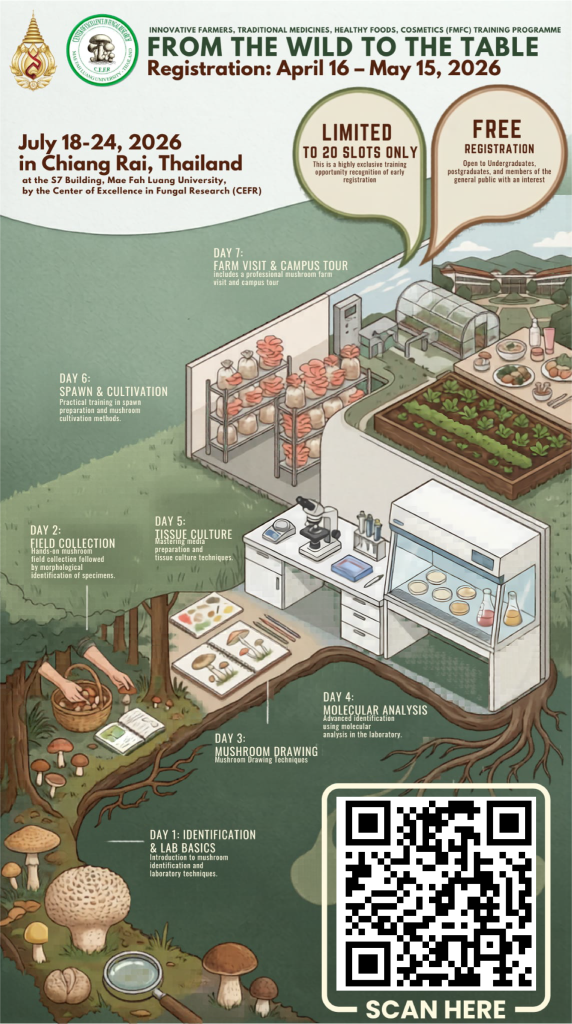
The "Mushrooms from wild to table" workshop project consists of activities providing knowledge and hands-on practice in collecting wild mushroom samples. This aims to teach the utilization of biodiversity from national resources and raise awareness about the importance of biodiversity for sustainable conservation.
Activities include identifying wild mushrooms through morphology, learning about edible and poisonous mushrooms, and providing knowledge and practice in mushroom cultivation to promote sustainable agriculture. This project is open to interested participants to promote lifelong learning
Activity Framework (International Workshop - 7 Days):
Objectives
- To develop the Center of Excellence in Fungal Research into a hub for mycological knowledge in Asia.
- To disseminate knowledge, build networks, and exchange learning regarding biodiversity studies and the international utilization of mushrooms.
- For participants to gain knowledge about biodiversity and the utilization of mushrooms
Target Participants
Undergraduates, postgraduates, and members of the general public with an interest in mycology from across Southeast Asia (20 participants).
Training Duration & Format
- Duration: 7 days (within 7–15 days)
- Format: On-site / Hybrid / Laboratory workshop / Field demonstration
- Proposed Dates: During July 2026
Expected Benefits
- Output
- Participants gain an understanding and practical training in collecting samples, classification, and mushroom cultivation.
- Establishment of an international network (1 network)
- Outcome
- Participants recognize the value of biological resources and the necessity of biodiversity conservation for long-term sustainability.
- Participants gain knowledge and practice the entire mushroom cultivation process, which can be used for supplemental income or developed into sustainable agriculture.
- Participants strengthen a culture of collective learning within society.
- A network of participants is formed to exchange information and experiences and promote the appropriate use of biological resources.
- Impact
- Increased Biodiversity Awareness: Greater understanding of the roles of mushrooms and biological resources in the ecosystem leads to a higher appreciation of forests and natural resources.
- New Economic Opportunities: Participants can apply cultivation knowledge to primary/supplementary careers or local business development.
- Knowledge Transfer: A network of those interested in mushrooms and biodiversity is formed, which can expand into further conservation activities and transfer knowledge to future generations.