Project Title:
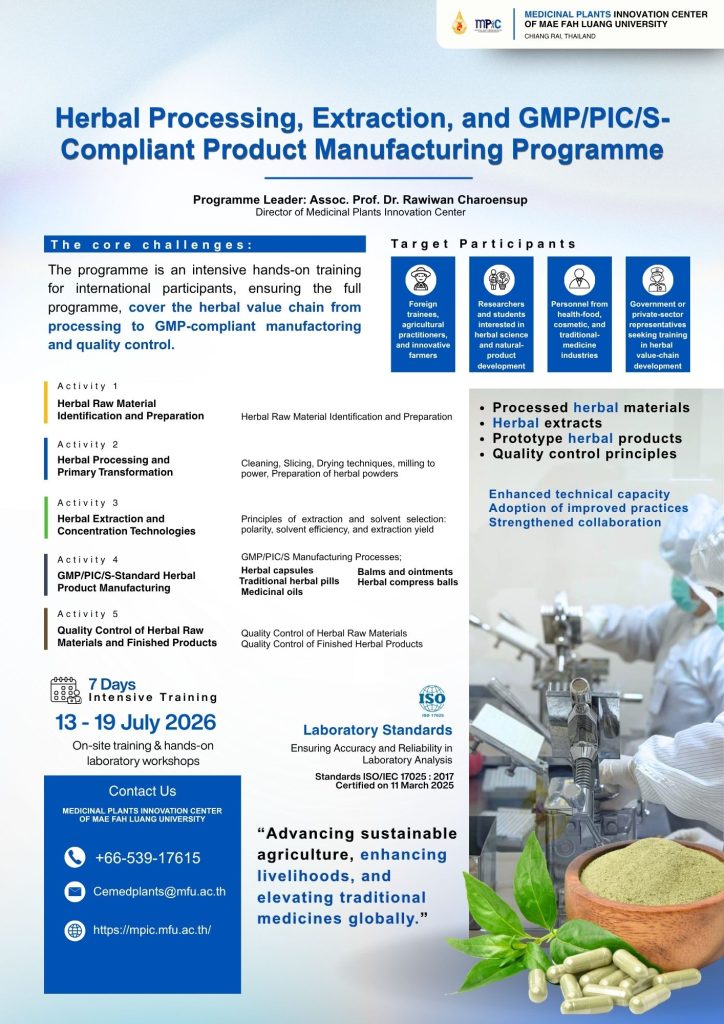
Herbal Processing, Extraction, and GMP/PIC/S-Compliant Product Manufacturing Programme
Programme Leader / Trainer
Assoc. Prof. Dr. Rawiwan Charoensup / Director of Medicinal Plants Innovation Center
Programme Overview (Brief Description)
This training programme is designed to enhance the technical capacity of international participants in the development of standardized herbal products for traditional medicine, healthy foods, and cosmetic applications. The programme focuses on herbal raw material preparation, processing, extraction technologies, GMP/PICs-compliant manufacturing, and comprehensive quality control, in alignment with national and international regulatory standards.
Participants will receive intensive hands-on training through laboratory workshops and pilot-scale manufacturing activities, covering post-harvest processing of herbal materials, extraction of bioactive compounds, formulation of herbal products in various dosage forms, and systematic quality control of both raw materials and finished products. Emphasis is placed on Good Manufacturing Practices (GMP/PICs), documentation, batch records, and quality assurance to ensure product safety, consistency, and regulatory compliance.
The programme integrates quality control methodologies based on the Thai Herbal Pharmacopoeia, WHO guidelines, and USP standards, enabling participants to understand and apply analytical testing, acceptance criteria, and product-release decision-making. By combining practical training with regulatory and quality-focused instruction, the programme aims to support the development of sustainable and innovative herbal industries that meet global market requirements.
Participants will engage in four major activity modules:
Activity 1: Herbal Raw Material Identification and Preparation
This activity focuses on preparing herbal raw materials prior to processing and manufacturing. Participants will learn how to authenticate, handle, and store herbal materials in compliance with quality and safety standards.
Key Topics and Activities:
- Introduction to medicinal plants and their industrial value
- Introduction to herbal raw materials used in traditional medicine, healthy foods, and cosmetic products
- Botanical identification of herbal materials (macroscopic and microscopic)
- Proper handling, labeling, and storage of herbal raw materials
- Prevention of contamination and degradation during storage
- Pre-processing quality screening before manufacturing
Activity 2: Herbal Processing and Primary Transformation
This activity provides hands-on training in post-harvest processing techniques to convert raw herbal materials into standardized intermediate products suitable for extraction and formulation.
Key Topics and Activities:
- Principles of post-harvest handling
- Cleaning and washing procedures
- Slicing, chopping, and size reduction
- Drying techniques (sun drying, oven drying, controlled drying)
- Milling, grinding, and sieving of dried herbal materials
- Preparation of herbal powders for further processing
Activity 3: Herbal Extraction and Concentration Technologies
This activity introduces participants to various extraction techniques used to obtain bioactive compounds from herbal materials, with emphasis on efficiency, safety, and quality.
Key Topics and Activities:
- Principles of extraction and solvent selection: polarity, solvent efficiency, and extraction yield
- Ethanol extraction (maceration/percolation)
- Essential-oil distillation techniques
- Aqueous extraction for freeze-drying
Activity 4: GMP/PIC/S Standard Herbal Product Manufacturing
This activity focuses on translating herbal extracts and processed materials into standardized herbal products under internationally recognized GMP/PIC/S requirements. Participants will learn step-by-step manufacturing and quality-assurance procedures to ensure product safety, efficacy, and regulatory compliance.
GMP/PIC/SManufacturing Processes; Hands-on production of various herbal formulations such as:
- Herbal capsules
- Traditional herbal pills
- Medicinal oils
- Balms and ointments
- Herbal compress balls
- Participants will be trained to follow GMP/PIC/S documentation, batch production records, hygiene protocols, and good manufacturing practices throughout all processing steps.
Activity 5: Quality Control of Herbal Raw Materials and Finished Products
This activity emphasizes laboratory-based analytical testing, in alignment with Thai Herbal Pharmacopoeia and GMP quality standards. Trainees will perform analytical methods, interpret results, and understand compliance requirements for the herbal industries.
Quality Control of Herbal Raw Materials
Participants perform QC checks aligned with Thai Herbal Pharmacopoeia and GMP standards, including:
- Moisture content determination (Loss on drying)
- Total ash and acid-insoluble ash determination
- Water content determination
- Volatile oil content determination
- Extractive value determination
Quality Control of Finished Herbal Products
Quality evaluation for different dosage forms, including:
- Microbial limit test (Specification)
- Heavy metal test (Specification)
- Moisture analysis for capsules/powders/tablets/pills/compressed balls
- Disintegration test for capsules/tablets/pills
- Weight variation test for capsules/tablets/pills
- Analysis of active compounds (qualitative & quantitative screening)
- Participants will learn the interpretation of QC results, regulatory specifications, stability considerations, and documentation requirements for product release.
Objectives
- To enhance understanding of post-harvest handling and primary processing of medicinal plants, including cleaning, slicing, drying, and powdering.
- To train participants in herbal extraction methods such as ethanol extraction, essential-oil distillation, and aqueous extraction for freeze drying.
- To strengthen participants’ ability to manufacture traditional medicine products under GMP/PIC/Sguidelines in various dosage forms (e.g., capsules, pills, tablets, oils, balms, creams, gels, compresses).
- To promote innovative thinking in applying herbs to healthy foods, functional products, and natural cosmetics.
- To support international knowledge exchange and capacity building for innovative farmers and herbal-product developers.
Target Participants
- Foreign trainees, agricultural practitioners, and innovative farmers
- Researchers and students interested in herbal science and natural-product development
- Personnel from health-food, cosmetic, and traditional-medicine industries
- Government or private-sector representatives seeking training in herbal value-chain development
Training Duration & Format
- Duration: 7 days
- Format: On-site training including laboratory workshops at Medicinal Plants Innovation Center, MFU Herbal Medicine Laboratory and MFU Herbal Processing Building
- Proposed Dates: 13-19 July 2026
Expected Benefits
Output
- Processed herbal materials (cleaned, sliced, dried, powdered)
- Herbal extracts produced through ethanol, water, or distillation methods
- Prototype herbal products manufactured under GMP/PIC/Sguidelines
- Principles of Quality Control for herbal raw materials and finished products.
Outcome
- Enhanced technical capacity among participants to develop herbal-based industries in their home countries
- Adoption of improved cultivation and processing practices aligned with international quality standards
- Strengthened collaboration between local experts and international trainees
- Increased potential for development of innovative health foods, traditional medicines, and natural cosmetic products
Impact
- Promotion of sustainable herbal agriculture and value-added herbal industries
- Improved livelihood opportunities for innovative farmers and rural communities
- Strengthened global recognition of traditional medicines and natural-product innovations
- Contribution to public health through access to safe, standardized herbal products